Digital-twin energy management for battery storage sites
Matrice ESS builds a digital twin of each storage site, from the grid connection down to each cell, and runs health, performance and safety models on it. Operators use it to run fleets, extend battery life, catch faults before the BMS trips, and size and augment new sites.
years managing battery life and performance, from BMS hardware to fleet twins
600+
MWh of storage managed on the platform
250k+
electric vehicles running the team's battery technology
10+
paid pilots with fleet, storage and EV customers
✦The problem// 01
The problem
What an operator cannot see from the BMS
Each battery management system estimates state of charge and health for its own pack, with its own firmware and its own limits. The EMS dispatches on those figures without checking them. On a multi-supplier site, nobody compares them against a model of how the battery should behave.
State of charge drifts
After a recalibration or a sensor fault, the reported state of charge can sit several points away from the real one. The site strands energy, or reaches a limit it did not plan for.
Operation sets the ageing rate
How a battery is held and cycled decides how fast it ages. A UPS fleet held at 100% state of charge ages faster than one on a managed set-point. Without an ageing model, that trade-off is invisible.
Faults start in one module
A hot module or a weak cell is visible hours or weeks before a pack-level alarm, if module data is compared with what the model expects at that load and ambient temperature.
−25%
usable energy lost when an NMC battery's state of health falls by 20%. Discharge time falls by 22%. Health is a revenue line for a storage site. Model illustration
✦Battery intelligence// 02
Battery intelligence
Life, performance and safety, computed from one twin
The platform turns raw telemetry into three kinds of decision. Each one rests on models of the battery, its application and the limits it has to operate within.
Life
Battery life extension
Find what accelerates ageing on each battery, simulate other operating strategies, and deploy the one that extends life while staying within warranty.
Lower cost of ownership · later replacement · higher residual value
Performance
Performance management
Estimate what each battery can still deliver at its current health (state of function), and predict failures weeks ahead by simulating expected use against actual use.
A predictive twin of every asset, built from blueprints
Most IoT platforms stop at level 2: they show data and help explain it. Matrice ESS is built for levels 3 and 4. It forecasts health and function for each battery, and recommends the operating change that keeps the site within its targets.
Fig. · Twin levels
Fig. · Platform architecture
Scroll sideways for the whole figure
Blueprints
A virtual model of the physical asset: its components, architecture and sensors. It spans the asset's life and is updated from live data.
Digital twin
One twin per asset, created from its blueprint without code. Forecast life, performance and the issues that lead to breakdowns.
Data ingestion
Streaming and batch ingestion with dataset audit. One access point to data spread across sites, suppliers and storage.
Models and simulation
Pre-built models run from day one. Your engineers can add their own through notebooks and the Python SDK.
✦Fleet// 04
Fleet
Every site and every battery in one view
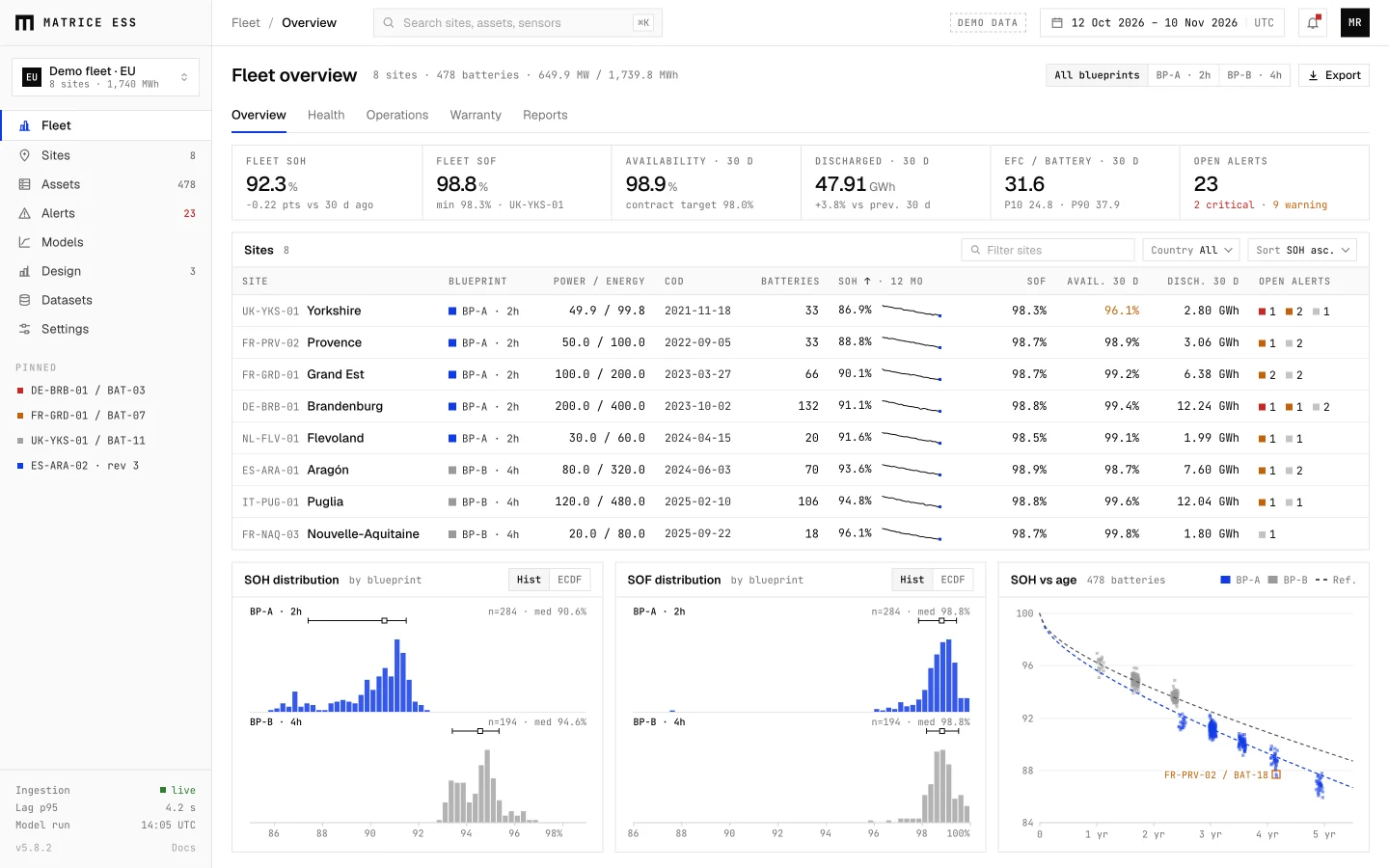
Sites are clustered by blueprint, so storage of different types and suppliers can be compared on the same health and function measures.
01
Fleet health
Energy, average state of health and active alerts across all sites.
02
Site table
State of health, state of function and availability per site, with trends.
03
Benchmark
SOH and SOF distributions compared across site types.
ess.matricetechnologies.com / fleetDemo data
✦Life// 05
Life
State of health, state of function, remaining useful life
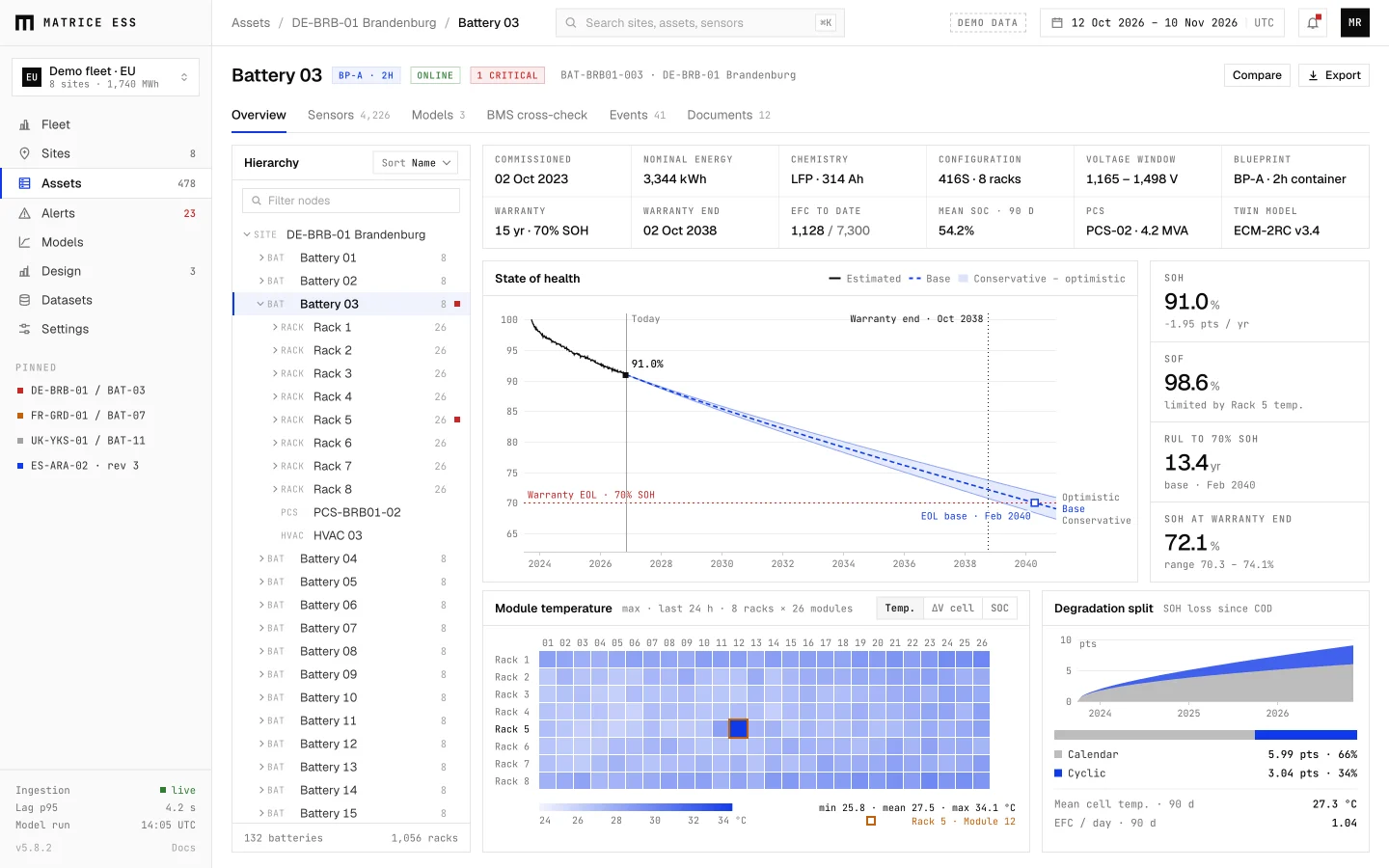
The state-of-health model is semi-empirical and works across chemistries. It covers calendar and cycle ageing and is recalibrated from online capacity checks. The state-of-function model then asks whether the battery can still deliver the power and duration its site needs. The date it stops being able to is its remaining useful life.
Scroll sideways for the whole figure
Aggregated across a fleet, remaining useful life becomes a decommissioning and augmentation schedule.
ess.matricetechnologies.com / assets / battery-03Demo data
Fig. · Asset twin: SOH history and forecast, remaining useful life, module heatmap
✦Performance// 06
Performance
An independent check on every BMS estimate
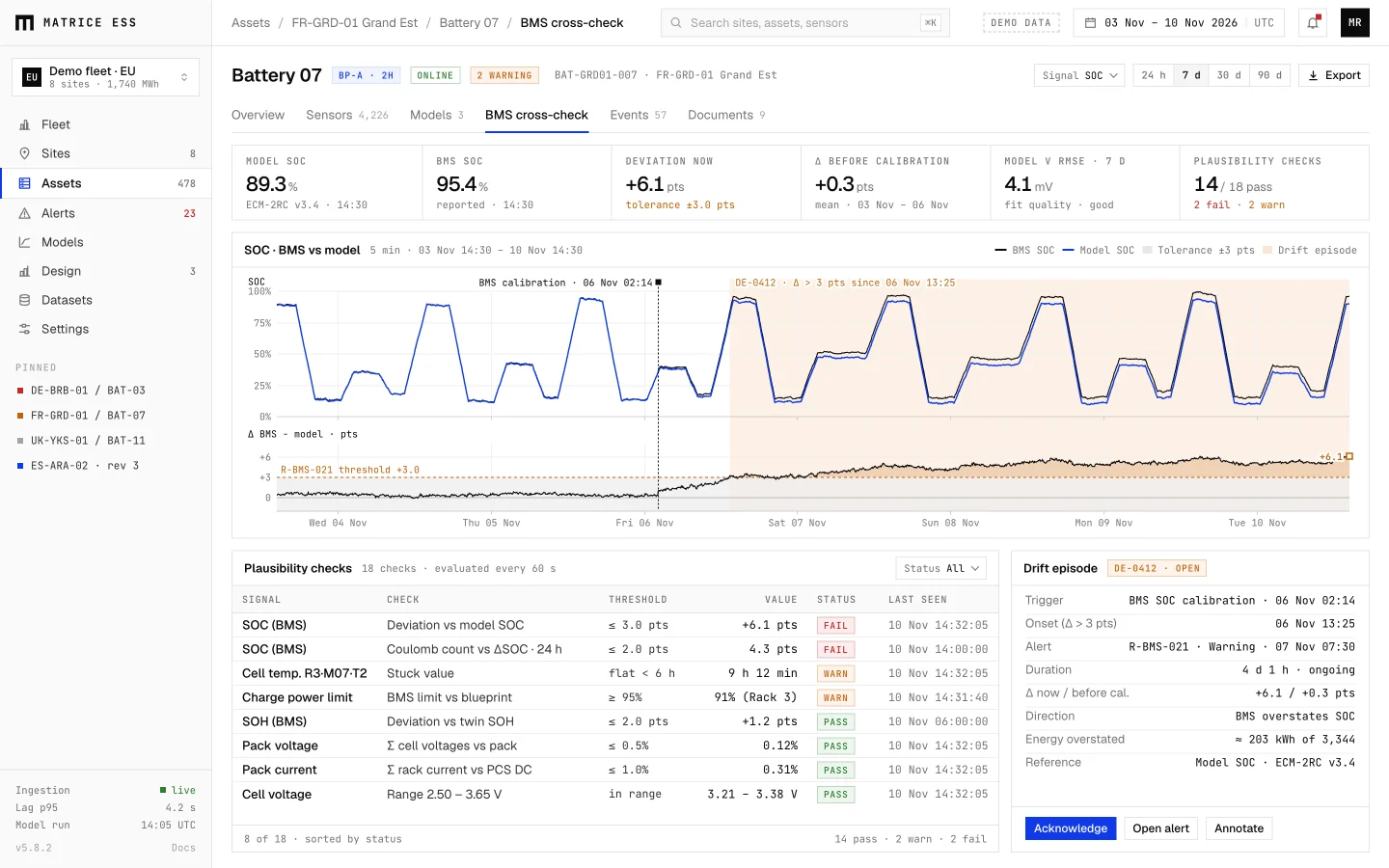
A real-time battery model runs beside each BMS and computes state of charge from current, voltage and temperature. When the two diverge, the platform says which one to trust and by how much.
01
SOC cross-check
BMS-reported against model state of charge, with drift episodes marked.
02
Plausibility checks
Stuck, noisy or out-of-range signals flagged before they reach dispatch.
03
State of function
Power and duration each battery can still deliver at its current health.
98.5%
accuracy of state-of-health estimates on an electric bus fleet, against measured capacity.
ess.matricetechnologies.com / models / bms-checkDemo data
✦Safety// 07
Safety
A preventive warning system above the BMS
Thermal runaway can start at cell, module, pack or system level, and each level can cause an event on its own. A BMS protects its own pack. Matrice ESS supervises the whole site: it fuses BMS data with system sensors and runs models that know what normal looks like.
Fig. · Detection to action
Scroll sideways for the whole figure
Fig. · Multi-dimensional safe operating area
Scroll sideways for the whole figure
Tiered warnings
Time-based, level-based and model-based tiers. A model warning fires when temperature departs from what the thermal model expects, well before the BMS limit.
Cell safe operating area
A configurable safety layer that does not touch BMS settings. It accounts for cell health and voltage, reports each excursion and adds up the stress.
System-level sensors
Pressure, smoke, gas and humidity sensors join the same twin, so swelling, leaks or condensation raise alerts next to the battery data.
Every alert tied to the module it concerns
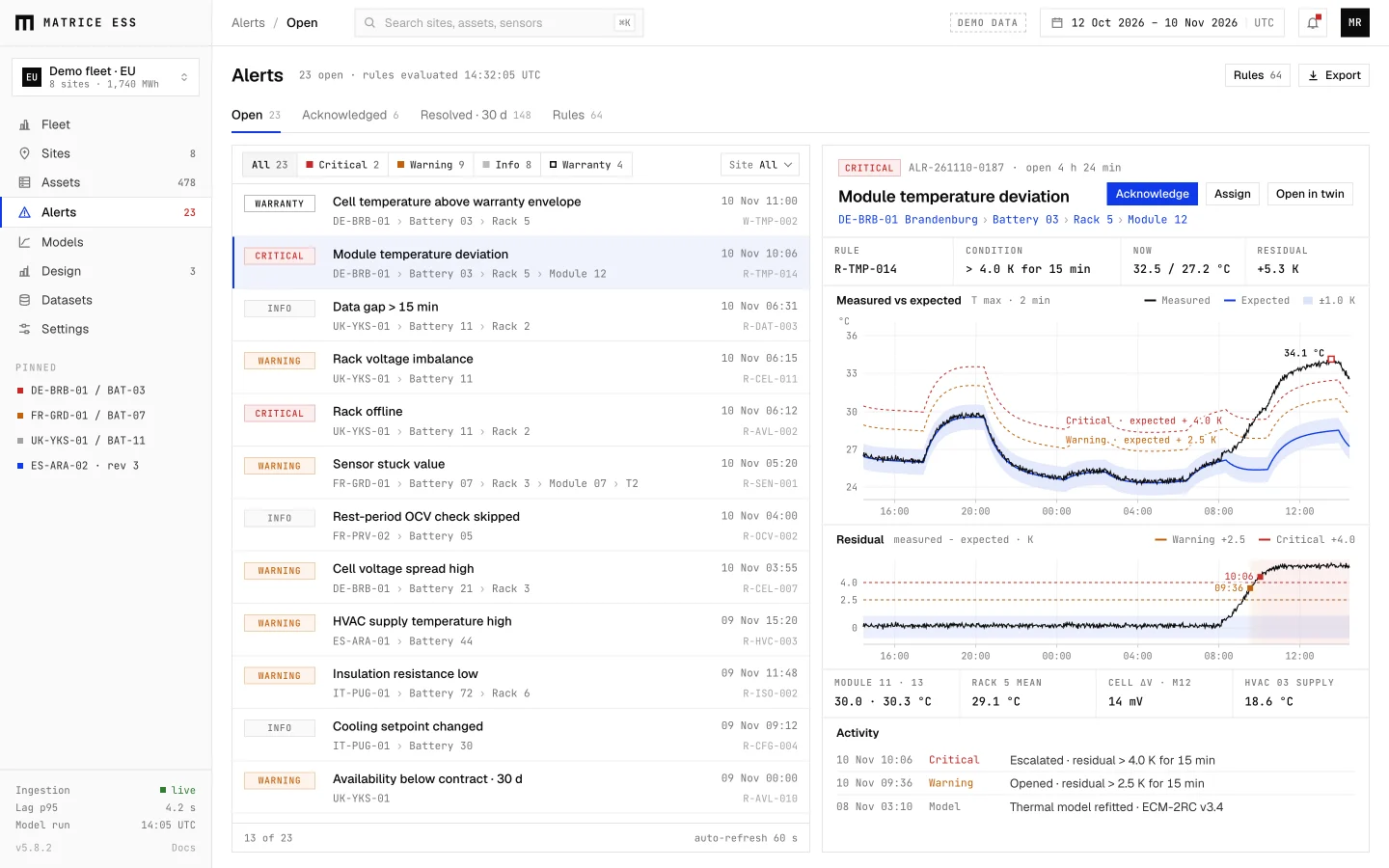
Alert rules combine several sensors with AND / OR conditions, carry a priority and a tier, and notify by email or text. Each alert keeps its full path in the twin and stays in the asset's history.
01
Alert queue
Critical, warning, info and warranty tiers, with the asset path for each.
02
Measured against expected
The reading, the model's expectation and the tier thresholds on one chart.
03
Warranty conditions
Operating limits from each supplier contract, checked on every reading.
ess.matricetechnologies.com / alertsDemo data
✦Design// 08
Design
Sizing, design checks and augmentation on the same twin
The design module sizes a site from its project requirements, builds the architecture from a component library across suppliers, and plans augmentation over the life of the asset. Its first release went into production with a utility-scale developer, with every capability signed off.
01
Automated solution design
Containers, PCS, transformers and bill of materials from the requirements.
02
Design-rule checks
Battery voltage window against PCS DC range, power and energy margins.
03
Augmentation planning
Usable capacity against requirement under degradation scenarios, year by year.
ess.matricetechnologies.com / design / solution-04Demo data
Screen · design / solution-04
✦Results// 09
Results
Measured on customer fleets
Three deployments of the platform before it became Matrice ESS. Customer names are available on request.
UPS fleet · global cloud provider
60%
battery life extension, up to
+35
months of average battery life
Challenge. Understand how operating conditions affect the health of UPS batteries.
Finding. Once the twin had put the fleet's data into one model, analysis showed the batteries were held at 100% state of charge, which aged them early.
Result. A dynamic state-of-charge set-point, recommended with zero downtime guaranteed, and further measures to extend battery life.
Pilot fleet of 2.6 MWh of UPS batteries, analysed on the twin before the strategy was rolled out.
Electric buses · OEM, India
98.5%
state-of-health estimation accuracy
2×
warranty extensions proposed, up to
Challenge. Use data from buses in service to choose chemistries and suppliers for new vehicles, and to build service revenue.
Result. End-of-life performance qualified by simulation; users segmented by a performance index to price warranty extensions.
“Their digital twin platform approaches the problem of battery intelligence with the context of our asset and operations.”
Storage operator · United States
600
MWh across sites, run by one operations person
$112k
recovered in liquidated damages
Challenge. No central system for several storage sites.
Result. Real-time site dashboards; warranty limits checked continuously, with every violation notified; battery-health cost included in trading decisions.
“We need the ability to optimise our bidding strategies while protecting the health of our batteries.”
✦Model library// 10
Model library
38 models, functions and pipelines
Released · 12
Alpha · 15
Prototype · 11
Life
Calendar ageing
Cyclic ageing
Rest-period identifier
Usage analyser
Charge-type classifier
Warranty-compliance tracker
Remaining useful life
Lithium plating
Adaptive charging optimiser
Performance
State of charge
Real-time battery model
State of function
SOC-error estimation
Dispatch strategy analyser
State of power
State of energy
Impedance
Storage system performance model
Safety
Safe operating area
Cell imbalance and prognostics
Temperature gradient and prognostics
Temperature transient analysis
Thermal-runaway prognostics
Resistance and heat dissipation
Thermal-management verification
State of overload
Platform and data
Ontological IoT layer
BMS data cleansing
Dataset audit
Model deployment pipeline
Scheduling engine
Simulation toolkit
Battery status reports
Time-series visualisation
Event-driven orchestrator
Datasheet-to-twin converter
Open to your engineers
REST API, an open-source Python SDK and hosted notebooks. Write a model once and the deployment pipeline packages, versions and rolls it out to every twin that matches its blueprint.
Corrected data stays marked
Cleansing never overwrites a reading. Every modified value is versioned and flagged, so each model result can be traced back to the raw data behind it.
✦Working together// 11
Working together
Deployed in weeks, starting from one site
Phase 0 · Data audit
What your data already says
We load a few months of history from one site and audit it: gaps, drift, and where the BMS and our models disagree.
Phase 1 · Pilot
One site on Matrice ESS
Blueprint, twin, cross-checks and alerts on live data, reviewed each week with your operators.
Phase 2 · Fleet
Every site, run by your team
More sites and the modules you need, with your engineers trained to run the platform and add their own models.
The team behind ION Energy and Altergo
Scroll sideways for the whole figure
Alexandre Collet
Co-founder, Matrice Technologies. Former CTO of Altergo. Co-founded ION Energy, which built the BMS business acquired for $40M.
JB Collet
Co-founder, Matrice Technologies. Former head of software at Altergo, where he built the digital-twin platform and its model stack.
Data audit
Send us three months of data from one site
We return an audit of what the twin sees that the BMS does not.